
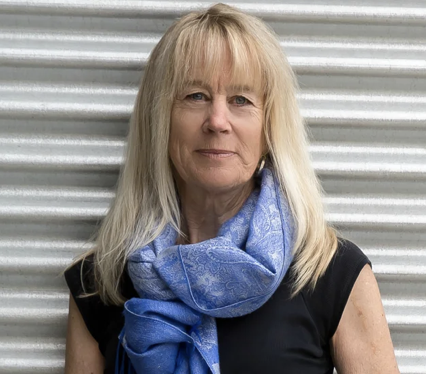
April Recap of Creating Memorable Characters with Peggy Townsend
by Bill Baldwin and Amanda Senior
Peggy Townsend, our April speaker, shared insights she has acquired writing her series of mysteries. After 33 years as a journalist covering the cops beat, Townsend is well placed as a crime fiction writer. “I know more serial killers than is good for me.” She’s familiar with cops, convicts, morgues, and graveyards: a hefty dose of hands-on experience!
Townsend’s latest mystery, The Botanist’s Assistant, centers around Margaret Finch, a six-foot-tall, big-boned, mid-life research assistant to a charismatic botanist at a small university. The inspiration for Finch came when Townsend met a Montanan Meals On Wheels service user who grew up in a small cabin without running water. “I was so touched by this woman who made her life into something of beauty,” said Townsend, “Margaret wants the same things—to be loved and accepted, while also solving a murder.” Later, hiking in Carmel with her sister, Townsend came upon the chimney and foundation of a homestead cabin, with views over mansions and houses in the valley. “This is where Margaret lives,” she thought. In her youth, awkward and friendless, Finch had been pelted by boys with slingshots as she walked home from school. Now Finch finds herself thrust into the role of detective in a race to catch a killer, before the killer catches up to her. Townsend’s sister, a scientist with a formidable knowledge of botany, greatly influenced Finch’s special interest in botanicals, making her the perfect detective to piece together this particular mystery.
How do you craft a riveting backstory like Finch’s?
Consider which characters in a story stick with you. As she wrote her book, Townsend’s character Margaret coalesced from a collection of people that she had met and who fascinated her.
Townsend finds people fascinating; she soaks up information from the people she encounters. As a journalist she had interviewed prisoners, criminals, police, agents, and many other people with unusual backgrounds. She thinks of some people she has encountered as “magpies” and “brain farms” who just keep providing interesting stories (she mentioned three old men she had met in North Beach, who kept telling her more and more details of the history and atmosphere of that neighborhood). “I meet people and ask them their stories, noting how they talk and interact. It’s a really successful way to build memorable characters. Accepted as they are, people like to talk. They tell you things that make you cry or blow you away.”
And actual Writing Rules?
Provide specific details of your characters—more than mere superficial points. Provide multiple aspects of the characters. To develop your skills, research actual people. Townsend’s experience in journalism was a definite plus.
Consider the characters’ human drive. What are they driven by? What makes them change and grow? Characters should change and grow! Peggy’s character Margaret wants respect and the truth. Give readers both the character and the story. Make your readers react. You want your readers to cheer your characters on! Present the characters through their voice.
Give your main character a sidekick, someone like Sancho Panzo. Sidekicks in a story are great!
Remember what James McBride said, that “a story is like a flower.” Things “go out” and “come back.” So in your story you can move a bit away from the central focus of the story, as long as you are sure to return to the main focus. As you continue this in and-out motion, make sure that the current scene adds to the story. Character-wise, keep asking what makes the character tick? Add layering and depth to your characters.
Lots of good advice and information! Peggy Townsend certainly inspired and motivated us to move ahead with our writing! Thank you, Peggy!